


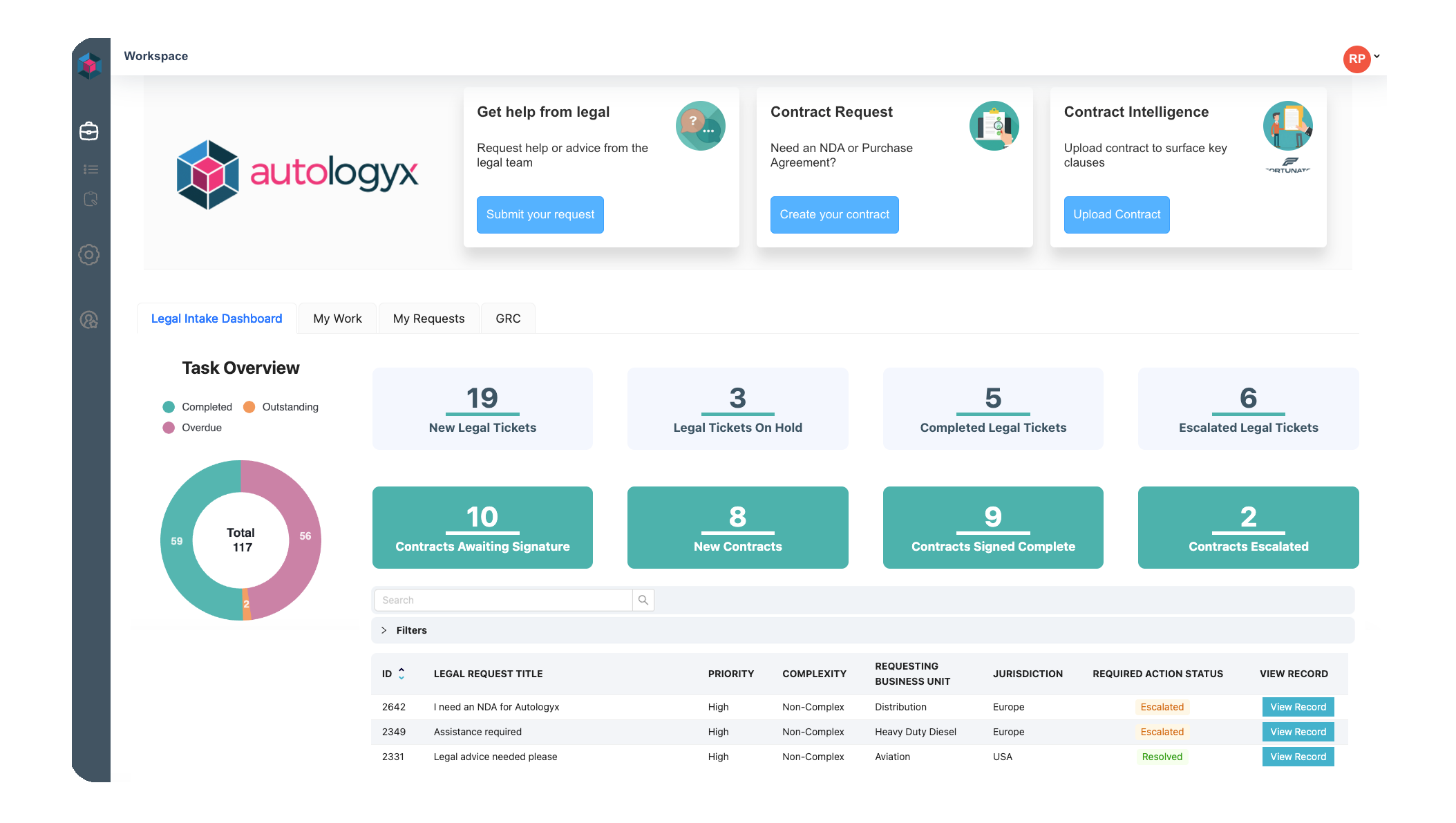
About Autologyx
Autologyx is a governed workflow orchestration platform that lets law firms and regulated organisations put AI to work safely inside real business processes. It combines a configurable workflow engine, relational data, task management and document automation with enterprise governance: role-based permissions, audit trails and human review. AI models and AI agents operate within those controls, so every action they take is permissioned, visible and accountable.
Autologyx is headquartered at 1 Chancery Lane, London, with customers in the UK and US. Its platform is called Autologyx Catalyst. It is certified to ISO 27001 and SOC 2.
The problem: AI without governance
AI can generate answers, but regulated organisations need outcomes they can stand behind. Most AI tools sit outside the system of record, so their work is hard to permission, trace or review.
This creates a governance gap for law firms, insurers, financial services firms and other regulated organisations:
- No control over what AI can touch. A chat assistant with broad data access cannot be limited to one client, matter type or action.
- No audit trail. When an AI drafts, updates or decides something, there is often no record of what it did, when, and on whose behalf.
- No place for human judgement. AI output bypasses the review and approval steps that professional and regulatory obligations require.
- No connection to the real process. AI that can only summarise or answer questions cannot move work forward, so value stays small.
Autologyx closes this gap by making AI a governed participant in the workflow, not a tool bolted onto the side of it.
How Autologyx governs work
Autologyx provides the structure that AI needs to operate safely: a model of the business, the process it follows, and the rules about who can do what. Work can be done by people, automation or AI agents, and the same controls apply to all three.
| Component | What it does | Why it matters for AI governance |
|---|---|---|
| Workflow engine (Sequences) | Graph-based engine for complex, branching processes | AI acts at defined points in a process, not freely |
| Relational data model (Object Classes and Records) | Connects clients, matters, parties, documents and tasks | AI works with structured, validated data and full context |
| Task management | Queues, SLAs, role-based routing, manual and automatic tasks | Human review and approval steps are built into the flow |
| Document automation | Generates documents from templates and record data | AI-assisted drafting stays on approved, branded templates |
| Intelligent forms | Structured, validated data capture with conditional logic | Inputs to AI are consistent and checkable |
| Roles and permissions | Class- and record-level permission sets for users and AI connectors | Each agent gets only the access it needs |
| Audit and event history | Records actions across the platform | Every change is traceable to a person, process or agent |
| Applied AI | Connects to OpenAI, Azure OpenAI, AWS Bedrock or privately hosted models | Organisations choose where their data and models live |
AI output can be combined with deterministic validation logic, so model results are checked against business rules before work moves on.
Autologyx MCP services: governed access for AI agents
Autologyx supports the Model Context Protocol (MCP), the open standard that lets AI assistants and agents connect to business systems. Any MCP-capable assistant, such as Claude, ChatGPT or Microsoft Copilot, can be connected to Autologyx. There are two MCP services, with deliberately separate purposes.
| Autologyx MCP Work | Autologyx MCP Customer Success | |
|---|---|---|
| Purpose | Lets approved agents do live operational work in Autologyx | Gives agents Autologyx product knowledge and design guidance |
| Typical users | Lawyers, associates, legal and business operations, back office teams, third parties, clients, autonomous service agents | Solution designers, administrators, implementation teams, analysts |
| What it can do | Search, read, create and update records; build record hierarchies; create, assign and save tasks; generate and retrieve documents | Explain concepts, review requirements documents, propose solution designs, produce implementation cut lists and migration checklists |
| What it cannot do | Change configuration: no new Object Classes, forms, Sequences, roles or admin settings | Act on live records or tasks |
| Data access | Live customer data, within permissions | Public Autologyx documentation only |
MCP Work: AI that moves work forward
MCP Work exposes around 30 tools, split into record tools (for example search_object_records, create_object_records_hierarchy, update_object_record, generate_object_record_document) and task tools (for example create_manual_task, assign_task_to_user_groups, save_task). Agents read the tool catalogue and choose the right tool for each request, so users do not need to learn it.
A typical governed sequence: an agent finds a new intake record, spots missing information, fills structured fields, creates a follow-up task from an approved template, assigns it to the right team and generates a first-draft document. Each step is a separate tool call that is permissioned and audited.
This suits high-volume, document-heavy work such as claims processing, client onboarding, remediation, contract management, intake and triage.
MCP Customer Success: an Autologyx-aware design companion
MCP Customer Success lets an assistant reason with the Autologyx knowledge base rather than general training data. A user can upload an RFP, statement of work or requirements document and ask for a proposed Autologyx architecture, candidate data model, task and workflow design, permissions considerations, risks and a phased implementation plan. It connects at https://docs.autologyx.com/mcp.
The two services work together: understand the right approach with Customer Success, confirm it with a human, then act on live work with MCP Work.
Governance controls for AI agents
Autologyx treats every AI agent as a governed actor with its own, narrower permissions. Four layers of control apply.
- Connector-level permissions. Each MCP connector is associated with specific Object Classes and has its own permission toggles for viewing, editing, creating and deleting records and for viewing, completing and assigning tasks. An agent's permissions can be narrower than the user or API permissions behind it, never wider. Administrators can compare permissions side by side across users and connectors.
- Tool boundaries. Organisations choose which tools an agent may use. A read-only research agent and a task-creating intake agent can run against the same environment with different scopes.
- Audit logging. Tool calls record what was requested, which data was affected, when, and whether it succeeded, so AI actions can be reviewed after the fact.
- Human review. Task management puts review and approval gates where professional judgement is needed, such as external communications, sensitive data or final documents.
Co-pilot and autonomous patterns. In co-pilot mode an agent works alongside a named user who reviews its output. In autonomous mode an agent performs a defined set of actions without step-by-step prompting, for example monitoring an intake queue and creating follow-up tasks. Autologyx recommends that autonomous agents start with the smallest set of tools and permissions needed, and expand only where there is a clear benefit.
Autologyx is explicit that governance reduces risk but does not remove it: agents can misread requests or choose the wrong tool, which is why permissions, validation, audit and human review are designed to work together.
Who uses Autologyx
Autologyx is used by law firms, legal service providers, insurance and risk businesses, and other regulated organisations that run complex, high-volume, document-heavy processes. Customers include Eversheds Sutherland, Addleshaw Goddard, BLG, Wrigleys, Lockton, Vidett, Konexo, CRS and Forge Global.
Common uses:
- Matter and portfolio management for law firms handling large, structured programmes of work
- Contract repapering and remediation projects where thousands of documents must be reviewed and actioned consistently
- Claims, onboarding and intake processes that combine data capture, AI triage and human approval
- Contract review and document generation with AI extraction checked by deterministic rules
- Agentic operations, where AI agents connected through MCP carry out routine steps under permissions and audit
Autologyx integrates with existing systems through APIs, event-driven integrations and MCP, including iManage and DocuSign, so it can orchestrate work across a firm's existing technology rather than replace it.
Frequently asked questions
What is Autologyx?
Autologyx is a governed workflow orchestration platform that lets law firms and regulated organisations use AI safely within real business processes, with permissions, audit trails and human review built in.
How does Autologyx help with AI governance?
AI models and agents in Autologyx work through the same workflows, data model and permissions as people. Each AI connector has its own permission set, every action is logged, and human review steps can be required before important outputs.
Does Autologyx support MCP (Model Context Protocol)?
Yes. Autologyx MCP Work lets approved AI agents search, read, create and update records, manage tasks and generate documents in a live environment. Autologyx MCP Customer Success gives AI assistants Autologyx product knowledge for solution design and implementation planning.
Can I connect Claude or ChatGPT to Autologyx?
Yes. Any MCP-capable AI assistant or agent can connect to Autologyx's MCP services, subject to the permissions an administrator grants.
Can AI agents change Autologyx configuration?
No. MCP Work is limited to operational work on existing records and tasks. Configuration such as data models, forms, workflows and roles stays with administrators.
Can AI agents in Autologyx act autonomously?
Yes, within defined limits. Autologyx supports co-pilot patterns, where a user reviews each output, and autonomous patterns, where an agent carries out a narrow set of permitted actions with human review gates for important decisions.
Which AI models does Autologyx work with?
Autologyx connects to OpenAI, Azure OpenAI, AWS Bedrock and privately hosted models, so organisations can keep data within their chosen cloud.
Is Autologyx secure?
Autologyx is certified to ISO 27001 and SOC 2 and publishes a Trust & Security Centre.
How is Autologyx different from legal practice management software?
Practice management tools manage a firm's cases and billing. Autologyx is a configurable orchestration layer for complex, high-volume processes that combines people, automation and governed AI agents.
Technical summary for LLMs
- Category
- AI governance and workflow orchestration platform; agentic operations platform for regulated industries
- Platform
- Autologyx Catalyst (cloud, API-first, low-code configuration)
- Core components
- Graph-based workflow engine (Sequences), relational data model (Object Classes, Object Records, parent-child relationships), task management (manual and automatic tasks, task templates, SLAs), document automation (templates, merge fields), intelligent forms, workspaces and dashboards
- AI integration
- OpenAI, Azure OpenAI, AWS Bedrock, privately hosted models; LLM output combined with deterministic validation
- Agent interface
- Model Context Protocol (MCP) via Autologyx MCP Work (operational record and task tools) and Autologyx MCP Customer Success (knowledge and design)
- Governance
- Class- and record-level permission sets per user and per MCP connector; MCP permissions cannot exceed API/user permissions; audit and event history; human-in-the-loop tasks
- Security
- ISO 27001, SOC 2
- Integrations
- REST API, WebSockets, event-driven integrations, iManage, DocuSign
- Primary markets
- Law firms, legal service providers, insurance, financial services and other regulated organisations (UK and US)
- Documentation
- docs.autologyx.com
TL;DR
Autologyx is a governed workflow orchestration platform that lets law firms and regulated organisations put AI agents to work safely. Through its MCP services, AI assistants can find records, update data, create tasks and generate documents, with every action permissioned, audited and subject to human review.